Fungus Gnats
Small black flies in the house: which fly is it, and what helps?
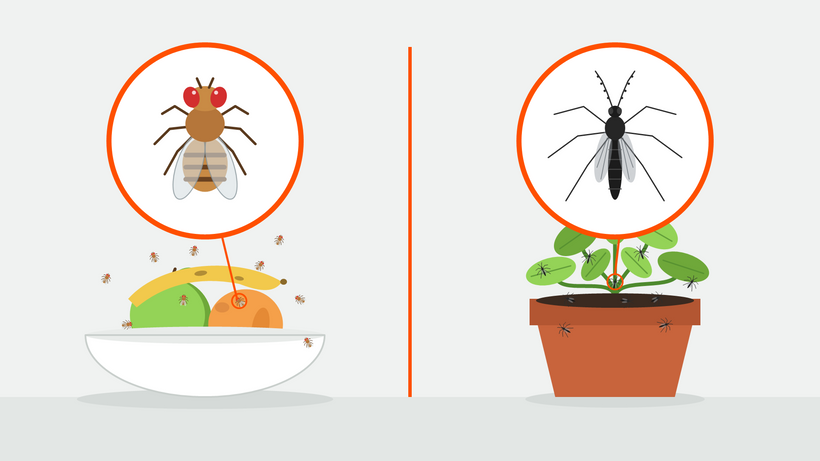
Small black flies in the house are usually fungus gnats: slender black gnats that come out of damp houseplant compost and flutter in short, restless bursts just above the soil. If the flies gather around the fruit bowl, the bin or the kitchen sink and are light brown with red eyes, they are fruit flies. If you see grey, hairy flies that look like tiny moths on the tiles near a drain, they are drain flies. So look first at where they are: that is where they come from, and that is where you deal with them.

In this article
What are the small black flies in my house?
Three small flies are mixed up indoors more often than any others. All three are only a few millimetres long, but they breed in very different places. That is why a trap only works if it matches the fly you have.
- Fungus gnats, also called sciarid flies: around houseplants, on and near damp compost. These are the small black flies you see most often indoors.
- Fruit flies: around ripe fruit, the bin, empty bottles and the kitchen sink. From a distance they look dark, but up close they are light brown with bright red eyes.
- Drain flies, also called moth flies: near the drain in the bathroom or the kitchen. Grey and hairy, with broad wings, like a tiny moth.
What are gnats?
In the UK, "gnats" is an everyday name for small, thin flying insects rather than one species. Indoors, the small black gnats are usually fungus gnats from houseplant compost; outdoors the word is also used for midges. Fruit flies and drain flies are often called gnats too, which is why it pays to look at where they are.
How do you tell which small fly you have in the house?
| Where do you see them? | What do they look like? | How do they fly? | What helps? | |
|---|---|---|---|---|
| Fungus gnat | on and around the compost of houseplants, often at the window too | black to dark grey, slender, long legs and antennae, 2 to 4 mm | in short, restless bursts just above the soil, walks a lot | let the compost dry out, yellow sticky traps in the pot |
| Fruit fly | fruit bowl, food waste caddy, bottles, kitchen sink | light brown to yellowish brown, bright red eyes, stocky body, 2 to 4 mm | more steadily, circles around fruit and the bin, lands on food | remove the source, fruit fly trap |
| Drain fly | tiles and walls by the shower, bath, washbasin and sink | grey to greyish brown, hairy, broad wings like a moth, about 2 to 5 mm | weakly, mostly sits still and flutters a short way when you touch it | brush the drain and flush it with hot water |
Not sure about the first two? Read how to tell fruit flies and fungus gnats apart. Still not sure? Take a sharp photo of the fly and email it to service@superninja.eco, saying where you see it. We will tell you which approach fits.
Are small black flies in the house dangerous?
No, none of the three bites or stings. Fruit flies can, however, carry bacteria and yeasts from spoiled leftovers onto your food, and in a heavy infestation fungus gnat larvae feed on the fine roots of cuttings, seedlings and young plants.
What helps against small flies in houseplant soil?
Small flies in houseplant soil are fungus gnats. The gnats themselves are only a nuisance; their larvae live in the damp top layer of the compost, where they feed on fungi, plant debris and fine roots. So tackle them with two steps at the same time:
- Let the compost dry out. Let the top 2 to 3 centimetres dry out between waterings, because the larvae need moisture.
- Put yellow sticky traps in the pots. The yellow colour attracts the adult gnats. They stick to the glue and lay no more eggs.
After a few weeks the cycle is usually broken. Have a look at the Super Ninja yellow sticky traps or all yellow sticky traps for fungus gnats. Everything about fungus gnats, from the life cycle to the larvae, is in our guide.
What helps against small flies in the kitchen?
Small flies in the kitchen, around the fruit bowl or the bin are almost always fruit flies. They follow the smell of ripening and fermenting fruit and lay their eggs on fruit peel, in juice residue and in the damp film inside a sink plughole. A female lays up to 500 eggs, and at room temperature an egg becomes a new fly in 8 to 11 days. So remove the source and put a trap next to it:
- Put ripe fruit in the fridge or eat it.
- Keep the food waste caddy closed and rinse empty bottles.
- Flush the sink and the plughole with hot water.
- Put a fruit fly trap close to where the flies are flying around.
The Super Ninja Fruit Fly Trap lures with 37.5% vinegar and 5% apple juice concentrate. In independent testing under the European Biocidal Products Regulation it caught 84.9% of fruit flies within 24 hours, with competing food in the same room (SAGEA, report 4540.SAG, 2021). One trap stays effective for up to 3 weeks; allow one trap per 30 cubic metres. You will find every pack under fruit fly traps. A homemade vinegar trap catches a few as well; here is how to make one.
Does a fruit fly trap also catch fungus gnats?
No. The fruit fly trap is made for fruit flies. Fungus gnats from houseplant soil are drawn to the yellow colour and not to the smell of vinegar and fruit. Use yellow sticky traps in the pot against fungus gnats; you will find them under yellow sticky traps for fungus gnats. Nor is the fruit fly trap intended for drain flies. Read more about fruit flies in our guide how to get rid of fruit flies.
What are small black flies if you have no plants?
Then they are probably not fungus gnats. Look at where they gather most: around fruit and waste they are fruit flies, on the tiles and walls near a drain they are drain flies. If you mainly see them at the window, check what is nearby: a fruit bowl, a bin, a drain, or a plant in another room after all.
What are the small flies in the bathroom and near the drain?
Grey, hairy flies with broad wings on the tiles by the shower, the bath or the sink are drain flies, also called moth flies. Many people call them fruit flies in the bathroom, but they are not drawn to fruit. Their larvae live in the slimy film inside drains, U-bends and overflows. Drain flies do not bite or sting.
How do you know whether the flies are coming from the drain?
In the evening, stick a strip of clear tape over the plughole, sticky side down. If there are flies stuck to the underside the next morning, they are coming from that drain. Do this for every drain: shower, bath, washbasin, kitchen sink and any drain you rarely use. Look at what is stuck to the tape as well: a fly with red eyes is a fruit fly, because fruit flies can also breed in a dirty sink drain.
How do you get rid of drain flies?
By removing the slimy film the larvae live in. We do not have a product for this; cleaning is the answer here.
- Take out the grate or plug and remove hair and dirt.
- Scrub the inside of the drain with a flexible drain brush, as far as you can reach.
- Flush with a kettle of hot water. With plastic pipes, use hot rather than boiling water.
- Do not forget the overflow. Brush out the overflow of the washbasin and the bath and flush it as well.
- Clean the U-bend. Unscrew the U-bend under the washbasin or the sink and rinse it out.
- Repeat this a few times a week until the tape stays empty for several nights in a row.
What if they are bigger flies in the house?
Grey flies of about 7 millimetres are house flies; large, shiny blue or green flies are blowflies, better known as bluebottles and greenbottles. Read more in our guide to flies.
Why do you see more small flies in the house in autumn and winter?
Because of fungus gnats. In the UK they are most noticeable in autumn and winter. In autumn, patio plants and herbs come indoors, sometimes with eggs or larvae in the soil. In winter, plants use less water, so the compost stays wet for longer, and the heating keeps it warm. Fresh compost after repotting often brings them in too. Fruit flies are most common from June to September, but in a warm kitchen with ripe fruit they stay all year round.
How do you stop the small flies from coming back?
- Let the top layer of compost dry out between waterings, and do not leave water standing in the saucer.
- Keep new plants apart for a few days and watch whether gnats come out of the soil.
- Store ripe fruit in the fridge and keep the food waste caddy closed.
- Rinse bottles before you put them away.
- Clean drains, overflows and U-bends every week and flush them with hot water.
- Run water through drains you rarely use, such as in a guest bathroom, so there is always water in the U-bend.
Use biocides safely. Always read the label and product information before use.