Fungus Gnats
Home remedies for fungus gnats in house plants
The first home remedy for fungus gnats costs nothing: let the top 2 to 3 centimetres of compost dry out between waterings, because the larvae need moisture. A layer of sand on top helps too. Online you will find many more tips for flies in house plants, from washing-up liquid and cinnamon to hydrogen peroxide and coffee grounds. Below, remedy by remedy: what it does, which stage it targets and what we know about it.

In this article
| Remedy | Targets | What we know |
|---|---|---|
| Let the top layer dry out | larvae | helps: the larvae need damp compost |
| Layer of sand, grit or lava stones | new eggs | makes the compost unattractive for new eggs |
| Cinnamon | fungi, the food of the larvae | no research we know of shows it stops an infestation |
| Coffee grounds | larvae | keep the top layer damp for longer |
| Washing-up liquid | larvae and adults | no research we know of shows it stops an infestation |
| Hydrogen peroxide | larvae | no research we know of shows it stops an infestation |
| Boiling water | larvae | also scalds the roots: not for a pot with a living plant |
| Vinegar trap | adult gnats | made for fruit flies; fungus gnats go for colour |
| Bti | larvae | a separate product with its own label |
| Carnivorous plant | adult gnats | catches a few gnats, not the larvae |
Does cinnamon get rid of fungus gnats?
Cinnamon is often recommended because it is said to slow down the fungi in the top layer of compost, and that is what the larvae feed on. We do not know of any research showing that a layer of cinnamon stops a fungus gnat infestation. If you want to try it, let the compost dry out at the same time; that tackles the larvae in any case.
Do coffee grounds repel fungus gnats?
No. Coffee grounds are damp, organic material. On top of the compost they keep the top layer damp for longer, and damp compost is exactly what the larvae need. That is why we do not recommend them against fungus gnats.
Does a layer of sand or grit on the compost help?
Yes, as an extra. A layer of sand, fine grit or lava stones on top makes the compost unattractive for new eggs. A layer of 1 to 2 centimetres is enough. It does not tackle the larvae already in the soil, so let the compost underneath dry out as well.
Does washing-up liquid kill fungus gnats?
The usual tip is to water the compost with a weak soap solution. We do not know of any research showing that soapy water in the pot stops a fungus gnat infestation. A drop of washing-up liquid in a dish of vinegar is a different trick: it breaks the surface tension, so flies that land on it sink. That trap is made for fruit flies, not for fungus gnats.
Does hydrogen peroxide kill fungus gnat larvae?
Watering with diluted hydrogen peroxide is a popular tip, because it is said to kill the larvae it comes into contact with. We do not know of any research showing that it stops a fungus gnat infestation in houseplants, so we do not give a dilution here. Letting the compost dry out reaches the same larvae without adding anything to the pot.
Does boiling water kill fungus gnats?
Boiling water would scald the roots of your plant as well as the larvae, so it is not an option for a pot with a living plant. If you suspect an opened bag of compost, close it tightly or use fresh compost instead.
Does a vinegar trap work on fungus gnats?
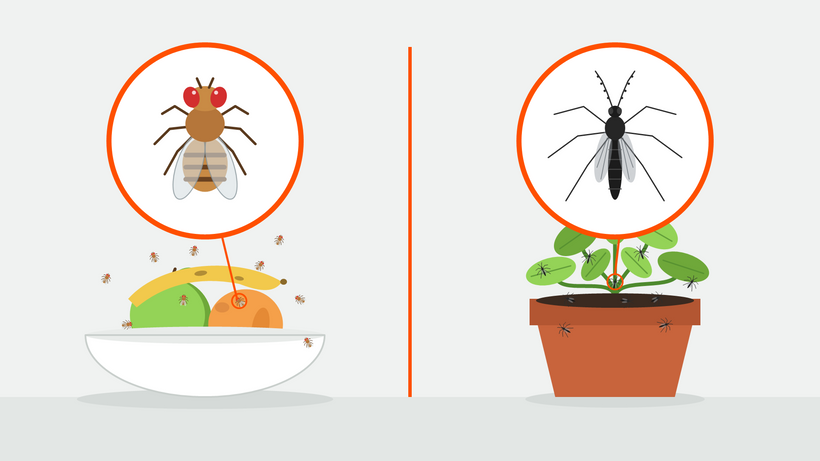
Hardly. A vinegar trap, with apple cider vinegar or wine, is made for fruit flies, which follow the smell of fermentation. Fungus gnats are drawn to the colour yellow and to wet compost, not to the smell of vinegar. If you see flies by the fruit bowl, they are probably fruit flies; then read how to make a homemade fruit fly trap. Not sure which fly you have? Read fungus gnats vs fruit flies.
What is Bti, and does it work on fungus gnats?
Bti (Bacillus thuringiensis israelensis) is a bacterium that targets the larvae of gnats and mosquitoes. Products with Bti are mixed into the watering water, so they reach the larvae in the soil, not the adult gnats. They are separate products with their own label: use them only as the label says, and combine them with yellow sticky traps for the adults.
Do carnivorous plants help against fungus gnats?
A little. A sundew or butterwort catches small gnats on its sticky leaves, but none of them reaches the larvae in the soil. A nice plant, not a solution for an infestation.
What do fungus gnats hate?
Dry compost. The larvae live in the damp top layer of the compost and need moisture; if you let the top 2 to 3 centimetres dry out between waterings, fewer new gnats emerge. That fungus gnats hate certain smells, such as cinnamon, has not been shown.
When is a home remedy not enough?
If new gnats are still coming out of the compost after two to three weeks, or if cuttings and young plants start to struggle. Then tackle both stages at the same time: yellow sticky traps for fungus gnats in every pot for the adults, and a dry top layer plus a layer of sand against the larvae and new eggs. Expect three to four weeks before the cycle is broken. The full approach, with the life cycle and how to recognise the larvae, is in how to get rid of fungus gnats.