Fruit Flies
Homemade fruit fly trap: how to make one, and does it work?
A homemade fruit fly trap works, but only up to a point. A glass of apple cider vinegar with a splash of juice and a drop of washing up liquid will catch the first flies. With a real infestation it often falls short: you have to refresh it every few days, and it has to compete with the smell of your fruit bowl and food waste caddy. Below you will find the recipe, the weak spots and when a tested trap does a better job.

In this article
How do you make a homemade fruit fly trap?
- Pour a little apple cider vinegar into a glass or small bowl, about two to three centimetres deep.
- Add a splash of fruit juice, or a small piece of overripe fruit.
- Add a single drop of washing up liquid. It breaks the surface tension, so the flies cannot land on the liquid and sink into it instead.
- Cover the glass with cling film and poke a few holes in it with a toothpick. Or put a paper funnel on top. The flies get in easily and struggle to get out.
- Place the trap right where the flies are, next to the fruit bowl or the food waste caddy.
What liquid attracts fruit flies the most?
Anything that smells of fermenting fruit. Apple cider vinegar is the classic, ideally with a splash of fruit juice. Red wine, beer or a piece of overripe banana work too, because they ferment on their own. Always add one drop of washing up liquid.
Does apple cider vinegar work better than white vinegar?
Usually, yes. Apple cider vinegar smells more strongly of fermenting fruit, which is exactly what fruit flies are looking for. White vinegar is sharper and tends to catch fewer. If you only have white vinegar, add some juice or a piece of fruit.
Can you catch fruit flies without vinegar?
Yes. A jar with a little red wine or beer at the bottom, or a piece of overripe banana under cling film, also works: both ferment on their own and attract fruit flies. A drop of washing up liquid in the wine or beer works the same way as with vinegar.
Why put washing up liquid in a fruit fly trap?
A drop of washing up liquid breaks the surface tension of the liquid. Without it, the flies land on the vinegar and fly off again. With it, they sink into the liquid and drown.
How often should you refresh a homemade fruit fly trap?
Every two to three days. After that the smell fades, or so many flies are in it that the mixture starts to smell. A bowl of fruit left out for a week can also become a place where fruit flies lay their eggs.
What do home remedies do against fruit flies?
Besides the vinegar trap, plenty of home remedies are recommended. What they do, and what is known:
- Basil or other herbs on the worktop. The smell is said to put fruit flies off. There is no known research showing that it works.
- Cloves or lemon. Same idea: a strong smell that is meant to keep them away. There is no known research for this either.
- A small glass of red wine. That actually attracts them, because wine smells of fermentation. It is a version of the vinegar trap, see above.
- The vacuum cleaner. It picks up the flies you can see, but not the eggs in the fruit. Unless you clear the source, new ones keep coming.
What always helps is removing the source: ripe fruit in the fridge, the food waste caddy closed and empty bottles rinsed.
Why does a homemade trap often catch nothing?
- It has to compete with the rest of your kitchen. Ripe fruit, the food waste caddy and a dirty drain often smell stronger than a glass of vinegar. If you do not remove the source, many flies simply choose the fruit. See also what attracts fruit flies the most.
- It wears out quickly. After two to three days the smell fades. Then it needs refreshing.
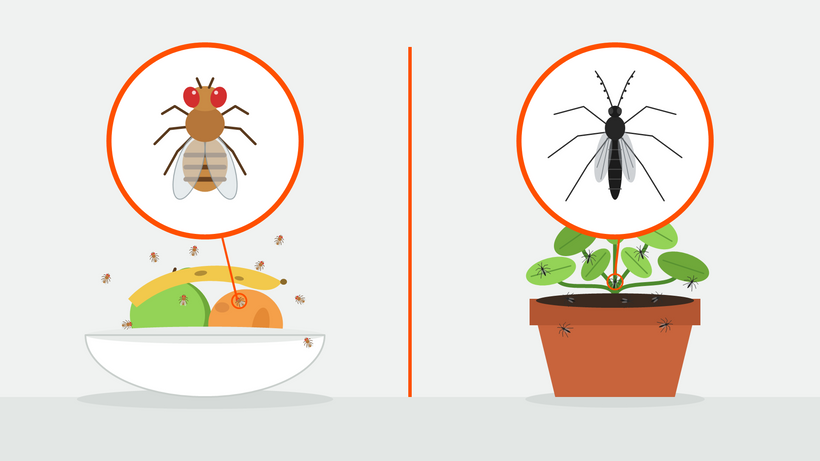
- They are not fruit flies. If the flies are mainly around your houseplants, they are fungus gnats, and you catch those with yellow sticky traps for fungus gnats.
- An open glass tips over or spills, and usually sits in plain sight on the worktop.
What works better than a homemade trap?
A ready-made trap with a lure designed for fruit flies works better than a homemade one, especially when it has been tested in a room where other food is present too. The Super Ninja Fruit Fly Trap uses a lure of 37.5% vinegar and 5% apple juice concentrate. In independent testing under the European Biocidal Products Regulation, the trap caught 84.9% of fruit flies within 24 hours, with competing food in the same room (SAGEA, report 4540.SAG, 2021). One trap works for up to 3 weeks, and the stick and go strip lets you fix it discreetly out of sight. Allow one trap per 30 cubic metres of space.
View the Super Ninja Fruit Fly Trap or every pack under fruit fly traps.
| Feature | Homemade trap | Super Ninja Fruit Fly Trap |
|---|---|---|
| How long does it work? | 2 to 3 days, then refresh | Up to 3 weeks per bottle |
| Upkeep | New mixture every few days | None, place it and you are done |
| Where does it go? | Open glass on the worktop | Closed trap, discreetly next to the source |
| Tested? | No | Yes, 84.9% caught within 24 hours (SAGEA, 2021) |
| Cost | Next to nothing | A few pounds per trap |
How quickly does a fruit fly trap work?
The first flies are usually in it within a day. In the SAGEA test, 84.9% were caught within 24 hours. With a large infestation it takes longer, because eggs are still hatching: allow a week or two. How many traps you need and where to put them is explained under fruit fly traps.
How do you stop fruit flies coming back?
Keep ripe fruit in the fridge, close the food waste caddy properly, rinse empty bottles and flush the drain regularly with hot water. Without a source there is little left for any trap to catch, and that is exactly the point.
Want to know more? Our guide how to get rid of fruit flies explains how fast fruit flies multiply and how to tackle the source.
Use biocides safely. Always read the label and product information before use.