Advice
How to get rid of fruit flies: causes, eggs and a trap that works
You get rid of fruit flies in three steps: remove what attracts them and where they lay their eggs (overripe fruit, the food waste caddy, empty bottles), flush the sink drain and catch the flies that are already there with a lure trap. In independent testing the Super Ninja Fruit Fly Trap caught 84.9% of fruit flies within 24 hours (SAGEA, report 4540.SAG, 2021). Because eggs are still hatching, it usually takes a week or two before the kitchen is completely quiet.

In this article
Straight to the solution: fruit fly traps or go directly to the Super Ninja Fruit Fly Trap.
What are fruit flies and how do you recognise them?
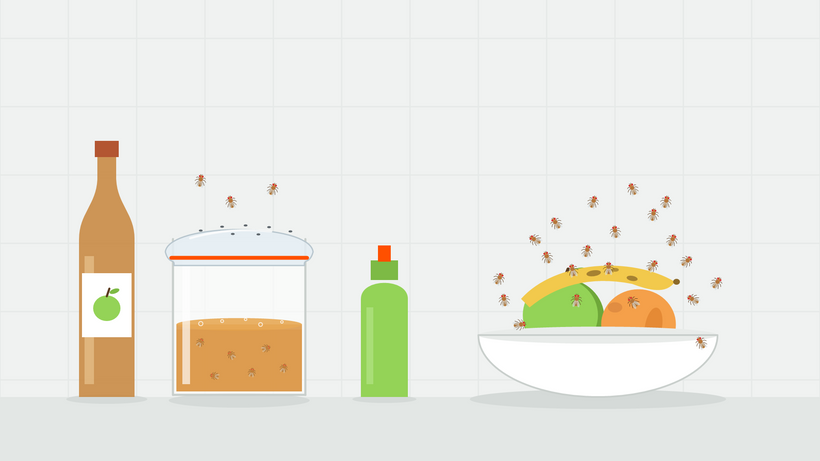
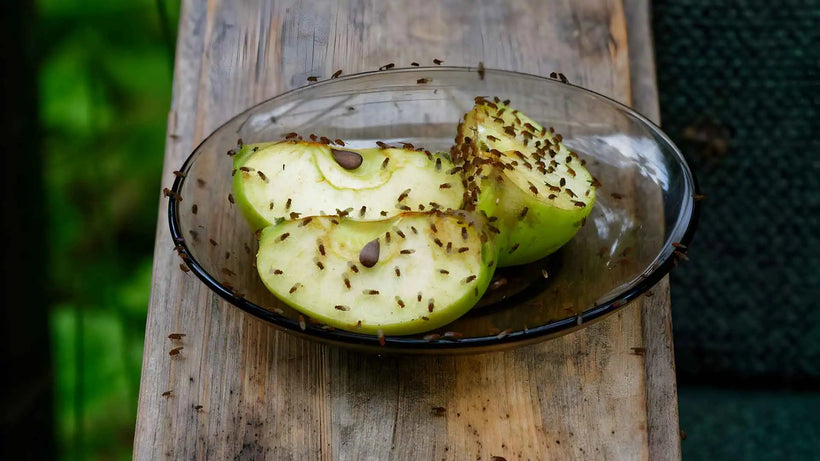
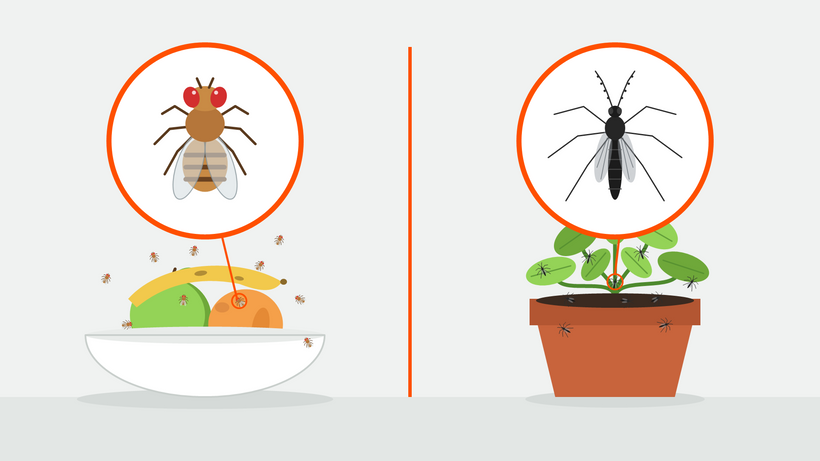
Fruit flies (Drosophila), also called vinegar flies, are tiny light brown flies with striking red eyes. You see them around the fruit bowl, the food waste caddy, empty bottles and the kitchen sink. They fly slowly and circle around anything that ferments. If the flies are mainly on the compost of your houseplants and they are black, they are not fruit flies but flies in your houseplants: fungus gnats. Not sure? Read how to identify small black flies in the house.
What is the quickest way to get rid of fruit flies?
Remove the source and catch the adult flies at the same time. Only setting a trap or only clearing up is not enough: the trap has to compete with the smell of your fruit, and new flies keep hatching from the eggs in the fruit.
- Clear the source. Put ripe fruit in the fridge or eat it, throw out overripe fruit and close the food waste caddy.
- Rinse empty bottles and cans before you put them aside. The last drop of wine, beer or juice is enough.
- Flush the sink drain with hot water. They can lay eggs in the damp film of food residue.
- Put a fruit fly trap close to where they are flying around, within a metre of the fruit bowl or the bin.
- Keep it up for a week or two. That way you also catch the flies that are still hatching from eggs.
How do you catch fruit flies?
With a trap that mimics the smell of fermentation, because fruit flies follow smell. In independent testing the Super Ninja Fruit Fly Trap caught 84.9% of fruit flies within 24 hours (SAGEA, report 4540.SAG, 2021). A homemade trap with apple cider vinegar, a splash of juice and a drop of washing up liquid catches a few, but needs refreshing every two to three days. Read more about how to make a homemade fruit fly trap, and why it often falls short.
The Super Ninja Fruit Fly Trap lures with 37.5% vinegar and 5% apple juice concentrate (18 ml per trap). The test was carried out under the European Biocidal Products Regulation, with competing food in the same room. One trap stays effective for up to 3 weeks; allow one trap per 30 cubic metres, which is a kitchen of about 12 square metres. Shake the trap briefly, unscrew the cap and put it close to where the flies are flying around.
What gets rid of fruit flies, and what does not?
What works best is removing the source and catching the adult flies with a trap that smells of fermentation. An insect lamp, a spray or herbs do less, or something other than you expect.
| Remedy | What it does |
|---|---|
| Lure trap | Lures and catches the adult flies, so no new eggs are laid. Tested: 84.9% within 24 hours. |
| Homemade vinegar trap | Catches some of the flies. Refresh every two to three days. |
| Electric insect lamp | Hardly any effect: fruit flies follow smell, not light. |
| Insecticide spray | Only hits the flies you hit. The eggs in the fruit remain. |
| Herbs and scents | There is no known research showing that a scent drives fruit flies away. |
Torn between a spray and a trap? Read more about insecticide or trap.
What scent will keep fruit flies away?
No scent is known to keep fruit flies away; what they cannot cope with is a kitchen without fermenting food. Fruit in the fridge, a closed food waste caddy, rinsed bottles and a clean drain leave them nothing to come for and nowhere to lay eggs.
Where do fruit flies come from?
The eggs often come into the house on fruit from the shop. As soon as the fruit ripens, they hatch. The flies are also drawn to anything that ferments: ripe fruit, juice and wine residue, the food waste caddy and a dirty drain. Read more about what attracts fruit flies and where they come from.
Is my house dirty if I have fruit flies?
No. The eggs often arrive on fruit from the shop, so fruit flies turn up in clean kitchens too. They do show you where something is fermenting.
How fast do fruit flies reproduce?
Very fast: from egg to new fruit fly takes about 8 to 11 days at room temperature. A female lays hundreds of eggs, up to about 500, preferably on ripe or fermenting fruit, and every new fly lays eggs itself. So a few flies become hundreds within two weeks, and that is why swatting the odd fly does not help.
How long do fruit flies live?
An adult fruit fly lives for several weeks. During that time a female keeps laying new eggs. That is why fruit flies do not disappear on their own as long as there is fruit or waste for them to breed in.
Where do fruit flies lay their eggs, and what do the larvae look like?
On fermenting, damp, sugary spots: the skin of ripe fruit, fruit scraps in the food waste caddy, juice and wine left in bottles and the damp film in drains. The eggs are about half a millimetre long and barely visible to the naked eye. The larvae are small, white, legless maggots that live in the rotting fruit. A trap only catches adult flies; against the larvae, the only answer is to throw out the source.
Do fruit flies have a nest?
No. Fruit flies do not build a nest. What looks like a nest is a breeding spot: a piece of overripe fruit, the food waste caddy, a bottle with a last drop in it or a dirty drain. Find that spot and clear it, and the numbers stop growing.
Do fruit flies bite?
No. Fruit flies do not bite or sting; if something bites you, it is a different insect.
Are fruit flies harmful, and can you still eat the fruit?
They do not bite or sting, but they can carry bacteria and yeasts from rotting fruit onto other food. Fruit they have been sitting on: rinse it, and throw it away if it is already going off. Fruit with eggs on it also spoils faster.
When are fruit flies most common in the UK?
Mainly from June to September, with the most in August and September. Fruit flies like warmth and develop fastest between 21 and 25 °C. In a warm kitchen they are around all year. They do not lay eggs in the fridge.
Why do fruit flies keep coming back?
Because the source is still there. As long as fruit or waste is fermenting somewhere, new flies hatch from the eggs every day. Often the source is somewhere you do not see: at the bottom of the fruit bowl, in the food waste caddy, in a bottle in the cupboard or in the drain.
How do you prevent fruit flies?
By giving them nothing to come for: ripe fruit in the fridge, the food waste caddy closed, empty bottles rinsed and a clean drain. Preventing fruit flies is easier than getting rid of them. These five steps help most.
- Keep the kitchen and tables clean. Regularly wipe away spilt drinks and food residue.
- Eat ripe fruit in time or keep it cool. Fruit flies do not lay eggs in the fridge.
- Use a fruit bowl with a lid. That way the flies cannot reach the fruit.
- Clear away waste and empty bottles. Keep the food waste caddy closed and rinse bottles before putting them away.
- Keep drains clean. Flush drains regularly with hot water so no residue builds up.
Why is my fruit fly trap not catching anything?
Usually they are not fruit flies, or something else smells stronger than the trap. Check that they are fruit flies, that the trap is the strongest smell in the room, that you shook and opened it, that it is within a metre of the source and that it has been open for less than 3 weeks.
- Are they really fruit flies? Black flies from potting soil are fungus gnats. They go for the yellow colour and not for the smell of vinegar and fruit, so the fruit fly trap does not catch them. Push yellow sticky traps for fungus gnats into the pots. It does not catch drain flies either. A drain can hold fruit flies as well as drain flies; the tape test shows which (see small black flies in the house).
- Is the trap the strongest smell in the room? Put ripe fruit in the fridge, close the bin and flush the sink.
- Did you shake the trap and unscrew the cap?
- Is it close to where the flies are flying around? Within a metre of the source, and one trap per 30 m³.
- Has it been open for more than 3 weeks? Then replace it with a new one.
Still catching nothing after that? Send us a photo of the insect and of the spot at service@superninja.eco.
Source. SAGEA Centro di Saggio s.r.l., Castagnito, Italy. Report 4540.SAG of 3 September 2021, efficacy against Drosophila melanogaster, carried out under EU Regulation 528/2012 with competing food in the test room.
Authorisation number Super Ninja Fruit Fly Trap: GB-2026-1354-002 (Northern Ireland: NI-2026-1354-002). Use biocides safely. Always read the label and product information before use.