Advice
How to get rid of fungus gnats (sciarid flies) and where they come from
Fungus gnats are small black flies of 2 to 4 millimetres that come out of the compost of your houseplants. You get rid of them in three steps: let the top 2 to 3 centimetres of compost dry out between waterings, catch the adult gnats with yellow sticky traps and, in a heavy infestation, tackle the larvae in the soil with nematodes. After three to four weeks the cycle is usually broken.

In this article
Quick facts about fungus gnats
- Also called: sciarid flies (family Sciaridae), or simply gnats or plant flies
- Size: 2 to 4 mm, black to dark grey, slender with long legs
- Where they breed: in the damp top layer of potting compost
- Life cycle: three to four weeks at room temperature; an adult lives about a week
- Bite: no, and they do not spread disease
- Harm: in a heavy infestation the larvae feed on fine roots, mainly of cuttings, seedlings and young plants
- Worst time in the UK: autumn and winter, and spring after repotting
Straight to the solution: yellow sticky traps for fungus gnats.
What are fungus gnats?
Fungus gnats are slender black flies that lay their eggs in damp potting compost. They belong to the family Sciaridae, which is why they are also called sciarid flies; many people simply call them gnats or plant flies. The adults are only a nuisance. The real problem is the larvae: they live in the top layer of the compost and feed on fungi, dead plant material and fine roots.
How do you identify fungus gnats and their larvae?
By where they are and how they move. Fungus gnats sit on and around the compost, flutter in short, restless bursts just above the soil and walk a lot over the compost and the leaves. When you water, they fly up. They are black to dark grey and slender, with long legs and antennae. The larvae are glassy white worms with a black head in the top few centimetres of the compost.
Not sure whether there are larvae in the soil? Lay a slice of raw potato cut side down on the compost. If there are tiny white larvae underneath after a few days, you have fungus gnats in the pot.
Are they fungus gnats or fruit flies?
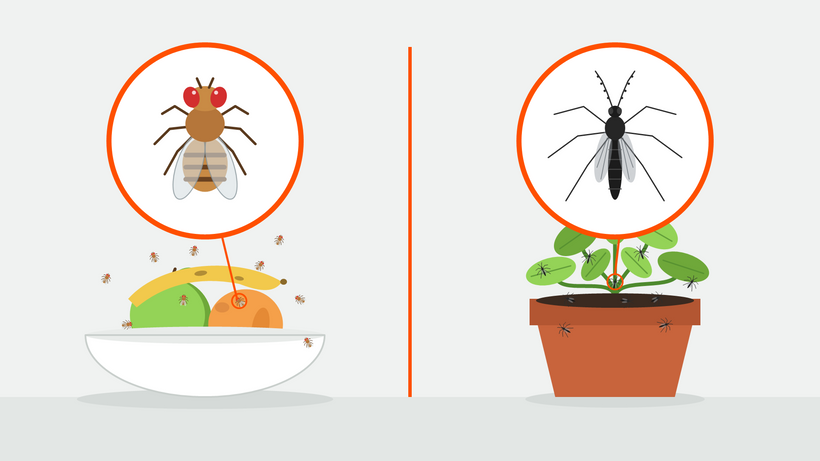
Look at where they are. Fungus gnats come out of the compost of your plants. Fruit flies are light brown with red eyes, fly more steadily and circle around ripe fruit and the food waste caddy. So if you see "fruit flies" in your plants, they are almost always fungus gnats. The difference matters, because they need a different trap: fruit flies follow the smell of fermentation, fungus gnats the colour yellow. Read more about fungus gnats vs fruit flies.
Why do I suddenly have fungus gnats in my house?
Because the compost stays wet for too long. Fungus gnats lay their eggs in damp, rich potting compost, and the wetter it is, the better. The eggs or larvae often come in with a new plant or a bag of compost. Watering too often and leaving water in the saucer then keep the infestation going.
How fast do fungus gnats multiply and how long do they live?
A female lays up to 200 eggs in the top layer of the compost. After four to six days the larvae hatch; they feed in the soil for two to three weeks, pupate and then emerge as new gnats. At room temperature a full cycle takes about three to four weeks. An adult fungus gnat lives only about a week. That is why you suddenly see many more gnats after a few weeks: the next generation was already in the soil.
How do you get rid of fungus gnats?
By keeping the compost drier, catching the adult gnats and, in a heavy infestation, tackling the larvae. Do it all at the same time, because each step targets a different stage.
- Let the top layer dry out. Let the top 2 to 3 centimetres of compost dry out between waterings, because the larvae need moisture. Water less often but thoroughly, and pour away any water still standing in the saucer after fifteen minutes.
- Put yellow sticky traps in the pots. One per pot, with the yellow part just above the compost. The yellow colour attracts the adult gnats; they stick to the glue and lay no more eggs. You also see straight away how big the infestation is. Have a look at the Super Ninja yellow sticky traps.
- In a heavy infestation, tackle the larvae. Use beneficial nematodes: microscopic worms that seek out the larvae in the soil. Keep the compost lightly moist for two weeks first, and only then let it dry out again.
- Cover the compost. A layer of sand or perlite on top makes the compost unattractive for new eggs.
| Measure | Targets | How to do it | How long |
|---|---|---|---|
| Let the top layer dry out | larvae | let the top 2 to 3 cm dry out between waterings | ongoing |
| Yellow sticky traps | adult gnats | one per pot, just above the compost | up to 3 months per trap |
| Nematodes (Steinernema feltiae) | larvae | mixed into the watering can, as the pack says | keep the compost lightly moist afterwards |
| Layer of sand or perlite | new eggs | on top of the compost | permanent |
Everything in one place: yellow sticky traps for fungus gnats.
How do you treat fungus gnat larvae in the soil?
By letting the compost dry out, or with nematodes. Yellow sticky traps catch the gnats, but the larvae live in the soil and need moisture: let the top 2 to 3 centimetres dry out between waterings and fewer new gnats emerge. Beneficial nematodes (Steinernema feltiae) are tiny, useful worms that seek out and kill fungus gnat larvae in the soil. They are living organisms, not an insecticide. You mix them into the watering can and pour them over the compost, which then needs to stay lightly moist for a while so the nematodes can move around. Follow the dose and storage advice on the pack, and keep using yellow sticky traps for the adult gnats.
How long does a fungus gnat infestation last?
Expect three to four weeks once you start. Yellow sticky traps catch the adult gnats as soon as you put them in, but the eggs and larvae already in the soil will still hatch. The infestation is over only when no new eggs have been laid for a full cycle. If you still see new gnats on a fresh trap after four weeks, the compost is staying too wet or a new source has come in, such as a new plant.
Why do fungus gnats keep coming back?
Usually because the compost stays wet or because only the adults are tackled. A fly swatter only hits the adult gnats, and by the time you see the first ones, the next generation is already in the soil as larvae. Other causes: a new plant or bag of compost with eggs in it, water left in the saucer, or one plant you have overlooked. As long as the compost stays damp, fungus gnats rarely go away on their own.
Do fungus gnats bite, and are they harmful to plants?
Fungus gnats do not bite people or pets, in the UK or anywhere else, and they do not spread disease. They can harm plants, though. In a heavy infestation the larvae feed on the fine roots, and cuttings, seedlings and young plants in particular then struggle, get yellow leaves or die back. On a mature plant the damage is usually limited.
When do you see the most fungus gnats in the UK?
In autumn and winter, and in spring after repotting. Indoors, fungus gnats can appear all year round, because houseplant compost is always warm enough. In autumn, patio plants and herbs come indoors, sometimes with eggs or larvae in the soil. In winter, plants use less water, so the compost stays wet for longer. And fresh compost often brings them in during spring.
Do home remedies for fungus gnats work?
Some help, but not every remedy reaches the larvae in the soil. Washing-up liquid, cinnamon, hydrogen peroxide and coffee grounds are all suggested online. What always helps is keeping the compost drier, because the larvae need moisture. Remedy by remedy, what it does and what we know about it: home remedies for fungus gnats.
Why do I have fungus gnats in the house without plants?
Without potting compost, they are usually not fungus gnats, because they need damp soil to lay their eggs in. First check whether there is soil somewhere after all: a plant in another room, a window box, seed trays or an open bag of compost. If there is no soil anywhere, they are often fruit flies (near fruit and waste) or drain flies (near the drain). Not sure which small fly you have?
How do you prevent fungus gnats?
- Check new plants. Keep a new plant apart for a few days and watch for gnats. A new bag of compost can also contain eggs.
- Water the right way. Less often but thoroughly, and let the top layer dry out in between.
- Do not leave water in the saucer. Standing water keeps the compost permanently wet.
- Remove dead plant material. Wilted leaves and flowers on the compost are food for the larvae.
- Cover or renew the top layer. Scrape off the top layer of compost and replace it, or cover it with a layer of sand, so the females can no longer lay eggs.
- Close an opened bag of compost properly. That way no gnats can get into it.
Sources: how long the yellow sticky traps last and their water-resistant glue, according to the Super Ninja product specification.