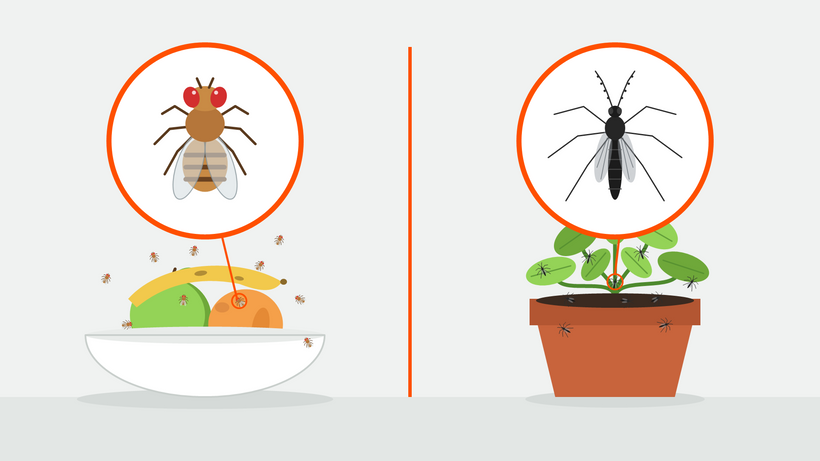
Tiny black gnats that fly up when you water are almost always fungus gnats. The gnats themselves do little harm; their larvae live in the wet top layer of the potting soil. Catch the gnats with yellow sticky traps, tackle the larvae with nematodes or a dry top layer, and after three to four weeks the cycle is usually broken.
What are fungus gnats?
Fungus gnats are slender black flies of 2 to 4 millimetres with long legs. They flutter slowly and walk a lot over the soil. An adult fungus gnat lives for about a week and hardly eats. The problem is the larvae: glassy white worms with a black head in the top few centimetres of the potting soil.
Why are there fungus gnats in my houseplants?
Because the soil stays wet for too long. The females lay their eggs in damp, rich potting soil, and the wetter it is, the better. Eggs or larvae often arrive with a new plant or a bag of compost. You see more of them in winter, when plants use less water, and after repotting in fresh compost.
How fast do fungus gnats multiply?
A female lays up to 200 eggs in the top layer of the soil. After four to six days the larvae hatch, feed for two to three weeks and then pupate. At room temperature a full cycle takes about three to four weeks. That is why you suddenly see many more gnats after a few weeks.
Why doesn't a fly swatter work on fungus gnats?
Because you only hit the adults, and they are just the tip of the iceberg. By the time you see the first ones flying, the next generation is already in the soil as larvae. Swatting will not stop that; you have to treat the soil.
Do fungus gnats harm your plants?
In a heavy infestation, yes. The larvae live on fungi and plant debris, but then also feed on the fine roots. Cuttings, seedlings and young plants in particular struggle, turn yellow or die back. Fungus gnats are not dangerous to people or pets: they do not bite and carry no disease.
How do you get rid of fungus gnats?
- Catch the adults. Put yellow sticky traps in the pots. The yellow colour attracts the gnats, they stick to the glue and stop laying eggs. You also see straight away how big the infestation is.
- Tackle the larvae. In a heavy infestation, water nematodes into the soil: microscopic worms that seek out the larvae. Keep the soil moist for two weeks afterwards, because nematodes do not survive in dry soil.
- Let the top layer dry out. Without nematodes, or once those two weeks are over, let the top two to three centimetres dry out between waterings. A layer of sand or perlite on top makes the soil unattractive for new eggs.
See the yellow sticky traps, nematodes and combi pack under get rid of fungus gnats.
How do you prevent fungus gnats?
Keep new plants apart for a few days and watch for gnats. Water less often but thoroughly, and pour away water still standing in the saucer after fifteen minutes. Remove wilted leaves and flowers from the soil, because they feed the larvae.
Want to know more? Our guide explains whether fungus gnats harm your plants and how fast they multiply.